Most phonics programs don't start with A and work through the alphabet in order. They start with a specific set of sounds — S, A, T, P, I, N — and there's a precise reason for that choice. Understanding why can help you teach phonics more effectively and explain the approach to parents who might find it confusing.
What Is SATPIN?
SATPIN refers to the first six phonemes (individual sounds) taught in many structured phonics programs. These sounds correspond to the letters:
- S — /s/ as in sun
- A — /æ/ as in cat
- T — /t/ as in tap
- P — /p/ as in pin
- I — /ɪ/ as in sit
- N — /n/ as in net
Programs like Jolly Phonics, Read Write Inc., and many others begin here rather than at A and working through to Z. This isn't arbitrary — it's a deliberate instructional decision rooted in what these six letters can do together.
The Core Reason: Real Words, Fast
The biggest reason phonics programs start with SATPIN is simple: these six letters can form dozens of real, decodable words immediately.
Once a child knows S, A, T, P, I, N, they can read and spell words like:
- sit, sat, sip, sin, snip
- pat, pan, pin, pit, pint
- tan, tin, tip, tap, nap
- ant, and, inn, nit
- it, in, is, at, an
That's meaningful reading from day one. Compare that to starting with A–B–C–D — after learning those four letters, a child can read almost nothing independently. The SATPIN sequence gets children into actual reading much faster, which matters enormously for motivation and confidence.
This connects directly to phonemic awareness — children who can hear individual sounds in words are primed to decode real words the moment they learn the letters that represent those sounds.
Why These Six Letters Specifically?
Several factors make S, A, T, P, I, N the ideal starting set:
1. High-Frequency Sounds
These sounds appear constantly in English text. S and T are among the most common consonants. A and I are two of the five short vowels, meaning they show up in enormous numbers of short words. Starting here gives children immediate payoff — they encounter these sounds everywhere they look.
2. Two Short Vowels Right Away
Most beginner phonics programs teach short vowels before long vowels because short vowels are more predictable. SATPIN includes both A (/æ/) and I (/ɪ/) in the opening set. This means children can practice CVC words with two different vowel sounds from the very beginning — instead of only being able to form words with one vowel pattern.
3. Visually and Physically Distinct Letters
Many early letter-confusion problems come from visually similar pairs — b/d, p/q, m/n. The SATPIN set deliberately avoids the most confusing of these. S, A, T, P, I, and N are relatively distinct from each other in both appearance and the physical feel of saying them. This reduces the cognitive load at the most critical early stage.
4. Mix of Continuants and Stops
S, N, and I are continuants — you can hold the sound out: sssss, nnnn. T and P are stops — short, crisp sounds. A is a vowel. Having a mix matters for blending practice. When children try to blend sounds together, continuants are easier to hold and connect. Starting with some of each helps children learn to blend without getting locked into habits that don't transfer.
SATPIN vs. The Alphabet Order: Why Alphabetical Doesn't Work
The alphabet order was designed to help children memorize the names of letters — not to teach reading. Letter names and letter sounds are different things entirely. The letter name "bee" doesn't tell you the sound /b/. The letter name "double-u" gives no hint about /w/. Teaching letters in alphabetical order means:
- Children learn many letters before they can form real words
- They're stuck memorizing in isolation rather than applying sounds
- Motivation can drop before the payoff arrives
- They may start to confuse letter names and letter sounds
Structured phonics programs — whether they start with SATPIN or a slightly different set — all share the same principle: choose the first letters based on what children can do with them, not on alphabetical convention.
This is one of the key distinctions between structured phonics and whole-language approaches. For a deeper look at that debate, see Structured Phonics vs. Whole Language.
How Different Programs Handle the Sequence
Not every program uses the exact same first six letters. You'll see variations:
- Jolly Phonics: S, A, T, I, P, N (slight reorder)
- Read Write Inc.: m, a, s, d, t (starts differently but same logic)
- Letterland: c, a, t, s, i (different starter, same principle)
- Synthetic phonics programs generally: 6–8 letters chosen for maximum early word-building
The specific letters vary slightly, but the underlying reasoning is consistent: choose letters that combine into many real words quickly.
For a full look at the sequence beyond SATPIN, this guide to the SATPIN sounds covers how to teach each letter and what comes next. After SATPIN, most programs move to letters like G, M, D, O, C, K — see why this next set unlocks early reading.
What Happens After SATPIN
Once children know S, A, T, P, I, N, they move into:
- More consonants: G, O, C, K, E, U, R, H, M, D, L, F, B
- Consonant blends and digraphs: sh, ch, th, bl, cr
- Long vowel patterns
- More complex phoneme combinations
The transition from SATPIN words to CVC words with more letters is where CVC blending practice becomes critical. Children need to move from blending SATPIN words like "sit" and "pan" to words like "dog," "run," and "bed" — and eventually into longer words.
If you want a full roadmap of that journey, this complete phonics guide covers the entire progression from first sounds to fluent reading.
Practical Tips for Teaching SATPIN
A few things that help when you're in this phase with your students or child:
- Teach the sound, not the letter name. S says /s/, not "ess." Always model the sound first.
- Use multisensory practice. Saying, writing, tracing, building with letter tiles — the more pathways, the stronger the learning.
- Start blending immediately. Don't wait until all six letters are introduced. Once children know S and A and T, blend "sat." Blending from day two or three reinforces why each sound matters.
- Keep sessions short and frequent. 10–15 minutes daily beats a long session twice a week.
- Celebrate real words. When a child reads "pin" or "nap" for the first time, make it a moment. That's actual reading.
SATPIN Worksheets and Practice Materials
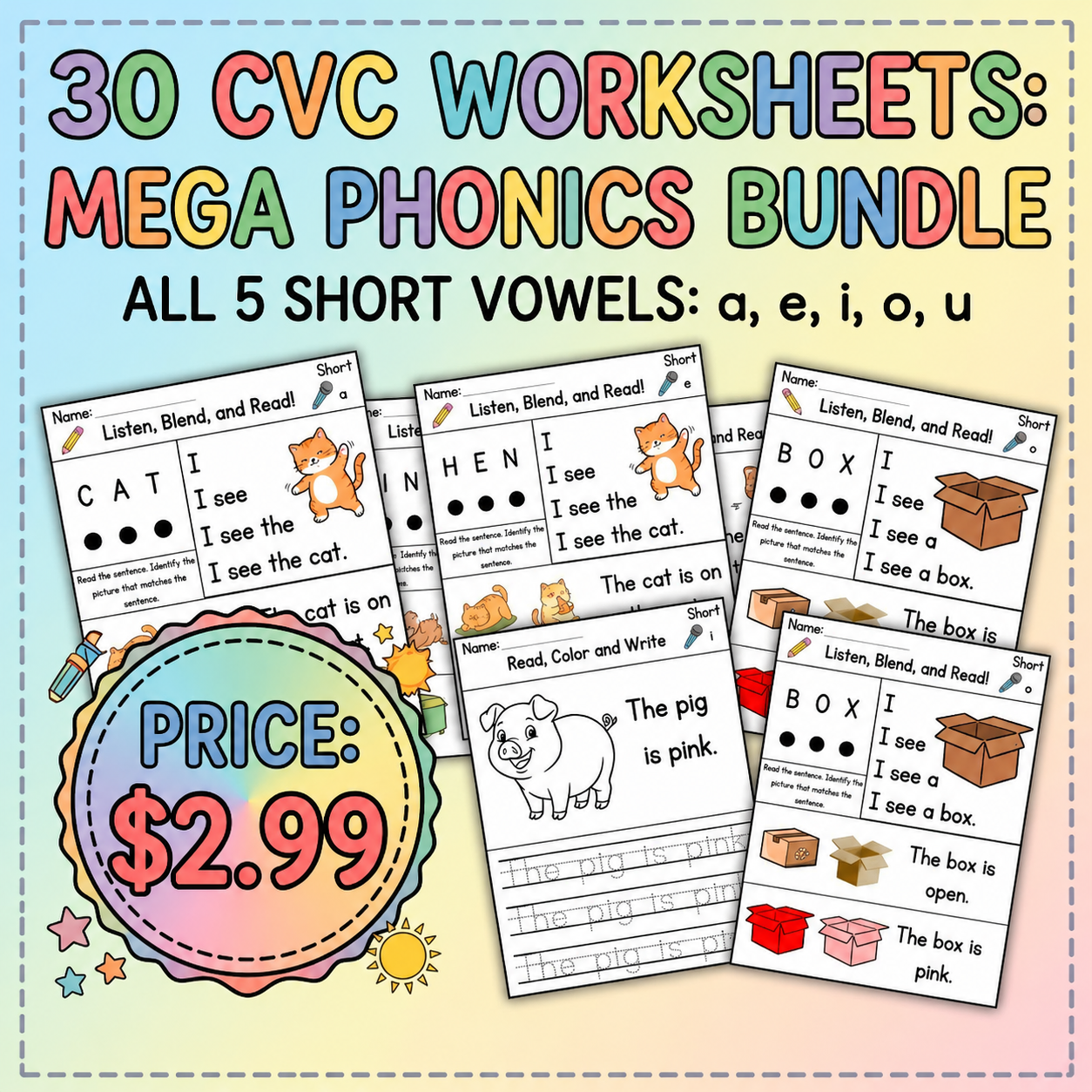
Structured practice reinforces what's being taught. Our SATPIN Phonics Worksheets Bundle covers letter recognition, beginning sounds, and handwriting practice for all six SATPIN letters — printable and ready to use straight away.
For blending specifically, the SATPIN Blending Worksheets focus on CVC word families using AT, IN, AP, AN patterns — exactly the words children can form once they know these six sounds.
The Bottom Line
Phonics programs start with SATPIN — not ABCDEF — because the goal of phonics instruction isn't to teach the alphabet. It's to teach children to read. The SATPIN set gives children the fastest path to decoding real words, builds confidence through immediate application, and avoids the most common early confusions.
Understanding the logic behind the sequence helps you teach it with more intention — and explain it clearly to parents who wonder why their child is learning "S-A-T-P-I-N" instead of starting from A.