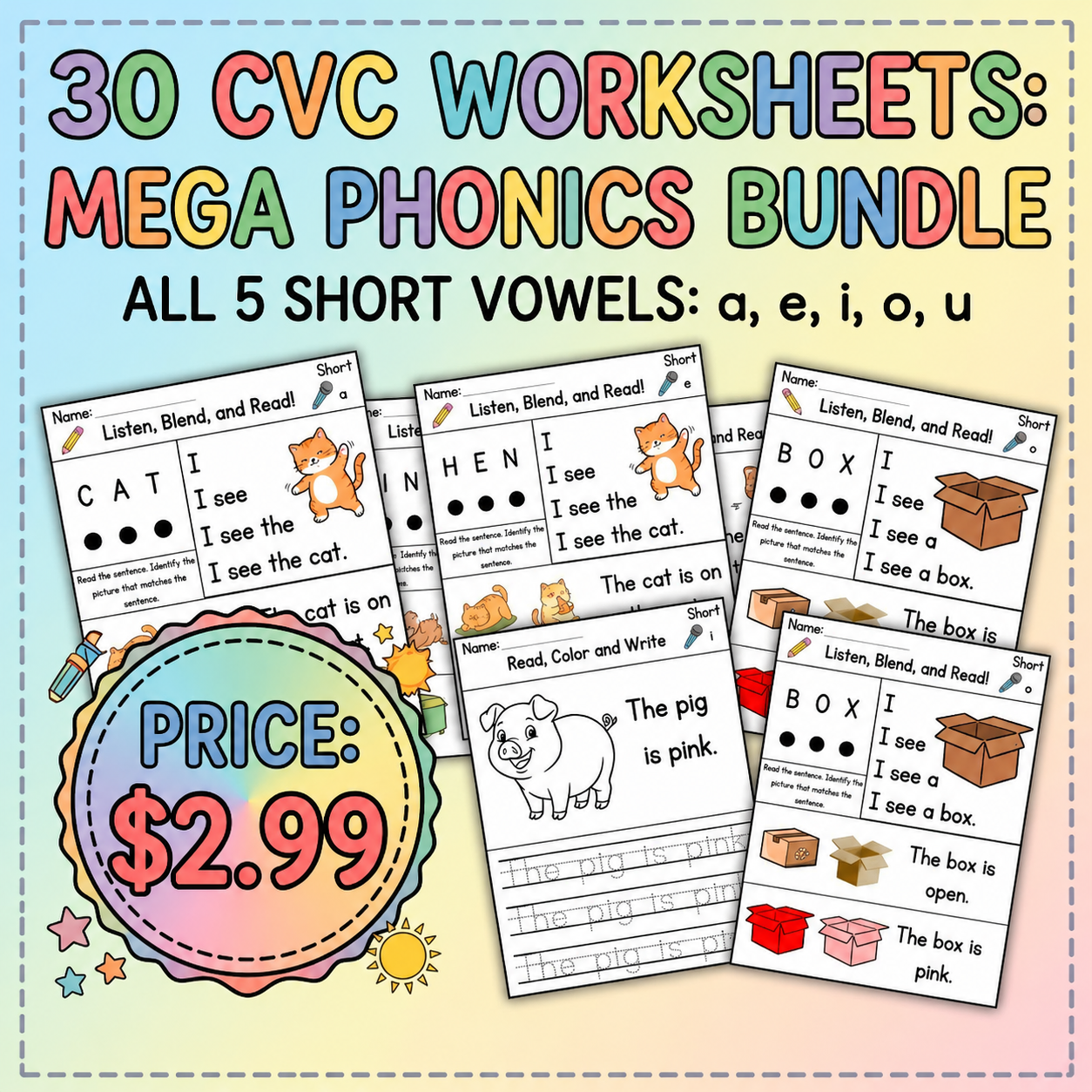
CVC words — three-letter words following a consonant-vowel-consonant pattern like cat, dog, sit, mop, run — are the foundation of early decoding. A child who can blend CVC words accurately has demonstrated that they understand how the alphabetic code works: that letters represent sounds that combine predictably to form words. That understanding is the engine of independent reading.
Why CVC Words Come First
CVC words are decodable from the first day a child knows a small set of letter sounds. They contain no silent letters, no digraphs, no vowel teams — just three sounds in a predictable order. This simplicity makes them ideal for early blending practice because every component is transparent. When a child reads "dog" by blending d-o-g, they have successfully decoded a real word using the alphabetic principle alone — no guessing, no memorisation required.
The ability to decode CVC words reliably is strongly predictive of later reading outcomes. Studies consistently show that early CVC word reading fluency is one of the best markers of whether a child will become a confident, independent reader by the end of second grade. Also read: CVC Word Families: The Fastest Path to Early Reading for how organising CVC practice by word family reduces the cognitive load for beginners.
The Role of Phonics Sequence in CVC Practice
CVC blending practice should use only the sounds a child knows. Children are frequently given worksheets with words containing sounds they have not yet learned, which teaches them to guess rather than decode. A structured phonics sequence (such as satpin followed by gmdock) ensures that blending practice is always fully decodable. Also read: Missing Middle Sounds: The Phonics Skill Most Parents Overlook for the specific challenge of medial vowels in CVC words.
Our Science of Reading Aligned CVC Blending Worksheets — gmdock Phonics Pack ($2.49) uses the g, m, d, o, c, k sounds to extend the satpin blending foundation your child has already built. Seven different activity types — Sound Blending Trains, Read and Match, Color the Correct Word, Missing Sound Detective and more — target every aspect of CVC blending without relying on a single repetitive format. The Science of Reading alignment ensures every activity builds the skills that lead to genuine independent reading.
How Much Practice Is Enough?
Daily practice of five to fifteen minutes with CVC words, sustained over four to six weeks, is typically sufficient for a child with no additional learning needs to develop reliable blending fluency. Practice should be varied — mixing oral blending, written decoding, word sorting and word building — to engage different memory systems and prevent boredom.
Frequently Asked Questions
What comes after CVC words?
CCVC words (with initial consonant clusters like bl-, cl-, st-) and CVCC words (with final clusters like -nd, -st, -mp) are the natural progression, introducing blending challenges at the beginning and end of words.
Should I use real words or nonsense words for blending practice?
Both have value. Real words build vocabulary connections; nonsense words test pure decoding without the option of visual recognition or guessing. A mix of both is the strongest approach.
My child memorises CVC words rather than blending them. How do I break this?
Introduce new words constantly so memorisation is not possible. Change one letter at a time to create minimal pairs (cat — hat — has) which forces decoding rather than whole-word recognition.
The Investment That Pays Off
Time spent on CVC blending practice is never wasted. The decoding habit built at this level generalises to all reading — every new word a child encounters in their reading life will be approached with the same systematic decoding strategy first established through CVC practice.