Phonics instruction teaches children to connect letters to sounds. But before that connection can be made, children need to be aware that spoken words are made of individual sounds in the first place. This prior ability — called phonemic awareness — is one of the strongest predictors of reading success and one of the most frequently skipped steps in early literacy instruction.
What Phonemic Awareness Actually Is
Phonemic awareness is the ability to hear, identify and manipulate the individual sounds (phonemes) in spoken words. It is entirely oral — no letters are involved. A child with phonemic awareness can tell you that "cat" has three sounds, that "cat" and "mat" rhyme, that "cat" without the first sound is "at," and that changing the first sound in "cat" to a b sound gives "bat."
This awareness is a prerequisite for phonics because phonics requires children to connect a visual symbol (a letter) to a sound they can already identify. If a child cannot hear that "cat" begins with the k sound, showing them that the letter c makes that sound has no anchor to attach to. Also read: Blending Sounds: How to Teach Children to Decode Words — blending is a phonemic awareness skill applied to print.
How to Develop Phonemic Awareness Before Phonics
Phonemic awareness develops through oral language activities: rhyming games, syllable clapping, initial sound identification, sound counting (how many sounds in "shop"?), and sound manipulation (say "cat" without the first sound). These activities require no materials — only attentive, playful interaction. Five minutes of daily phonemic awareness play in the year before phonics instruction begins produces measurable improvements in later reading outcomes.
For children who have reached phonics instruction with underdeveloped phonemic awareness, explicit phonemic awareness work should continue alongside phonics lessons — the oral component should slightly precede each new phonics skill.
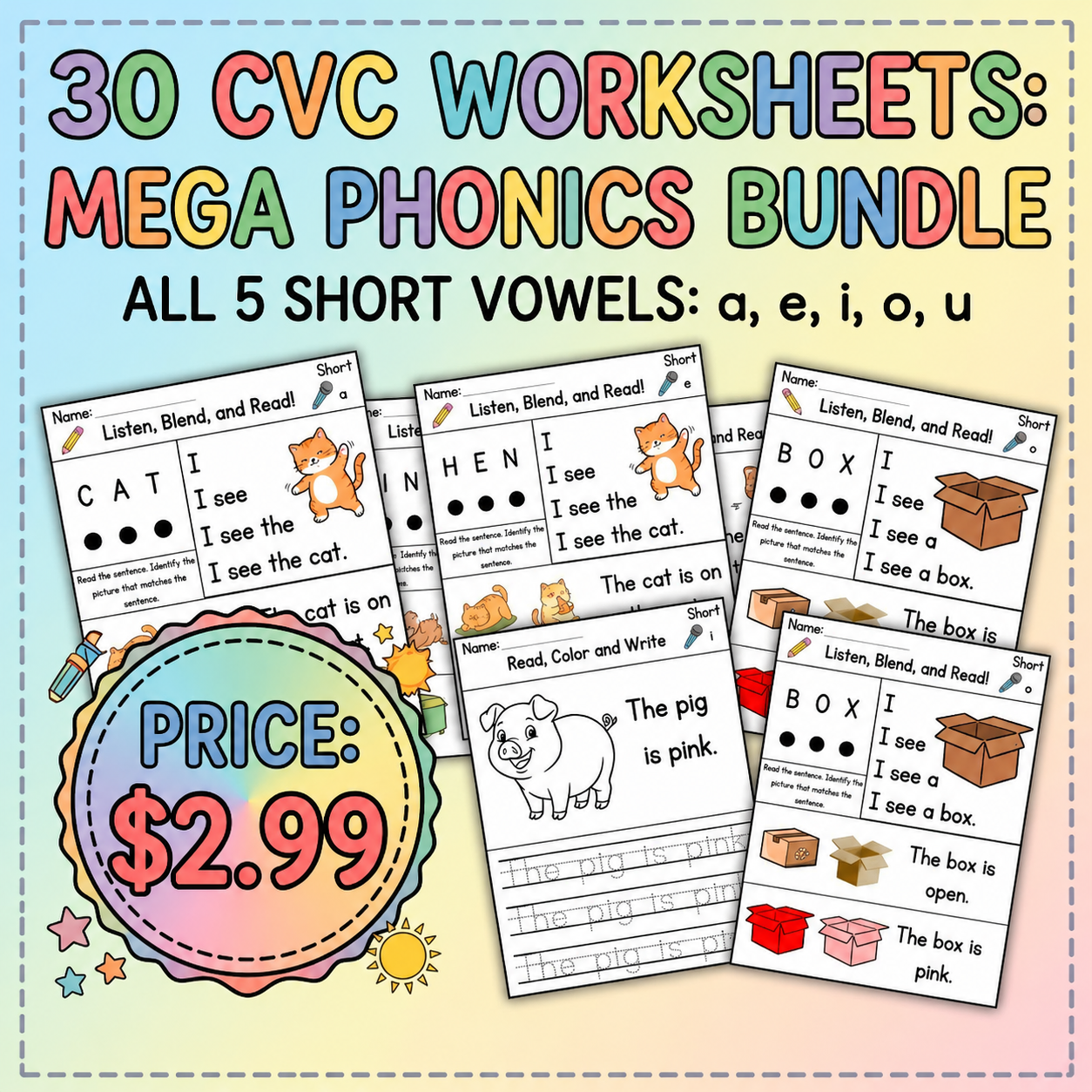
Our Science of Reading Aligned CVC Blending Worksheets — gmdock Phonics Pack ($2.49) is designed for children who have sufficient phonemic awareness to begin blending practice. Activities like Missing Sound Detective and Feed the Monster build phonemic awareness and phonics simultaneously — the oral and written components reinforce each other, exactly as the science of reading recommends. At $2.49, it is one of the most targeted early literacy investments available.
Signs That Phonemic Awareness Needs More Work
Children who consistently cannot isolate initial sounds in words, who cannot produce rhyming words, or who have difficulty counting syllables despite adequate language exposure may need focused phonemic awareness support before phonics instruction accelerates. These are not indicators of intelligence — they are indicators of a specific foundational skill that needs development.
Frequently Asked Questions
Can phonemic awareness and phonics be taught simultaneously?
Yes — and in practice, they often are. The key is that phonemic awareness (oral work) should slightly precede the phonics application of each new concept, even if by only minutes in the same lesson. The oral anchor must exist before the visual code is attached.
At what age should phonemic awareness be fully developed?
Most children with adequate oral language exposure have basic phonological awareness by age four. Phonemic awareness at the individual-sound level typically develops between ages four and six.
Is phonemic awareness the same as phonological awareness?
No — phonological awareness is the broader category, which includes sensitivity to syllables and rhymes. Phonemic awareness is the most granular level — individual phonemes. Both matter, but phonemic awareness is most directly linked to reading success.
Build the Foundation First
Phonemic awareness is not a prerequisite that children develop automatically with age — it is a skill that benefits from intentional development through language play. Invest in it early and every subsequent phonics lesson lands on prepared ground.