For decades, two approaches to early reading instruction competed for dominance: structured phonics, which teaches children to decode text by understanding letter-sound relationships, and whole language, which emphasises meaning-making, context clues and text familiarity. The research has now accumulated to an overwhelming consensus — and the implications for how we teach reading are significant.
What the Research Actually Shows
Meta-analyses and large-scale longitudinal studies consistently find that systematic phonics instruction produces significantly better reading outcomes than whole-language or "balanced literacy" approaches, particularly for at-risk readers and children with dyslexia. The Simple View of Reading (Gough and Tunmer, 1986) remains the dominant theoretical framework: reading comprehension equals decoding ability multiplied by linguistic comprehension. A child who cannot decode cannot access comprehension, regardless of how rich their oral language is. Also read: Why Phonics Works: The Research Every Parent Should Know for a deeper look at the evidence base.
What Whole Language Got Right — and Wrong
The whole language movement correctly identified that reading should be meaningful, that rich literature exposure matters, and that reading motivation is crucial for long-term achievement. What it got wrong was the instructional implication: that children learn to read by reading, through exposure and meaning-making, without explicit code instruction. For approximately one-third of children, this approach results in reading failure — not because those children are incapable, but because they need explicit instruction in how the code works.
The Science of Reading movement that has gained momentum since 2019 integrates the best of both traditions: explicit, systematic phonics instruction embedded in a rich language and literature environment.
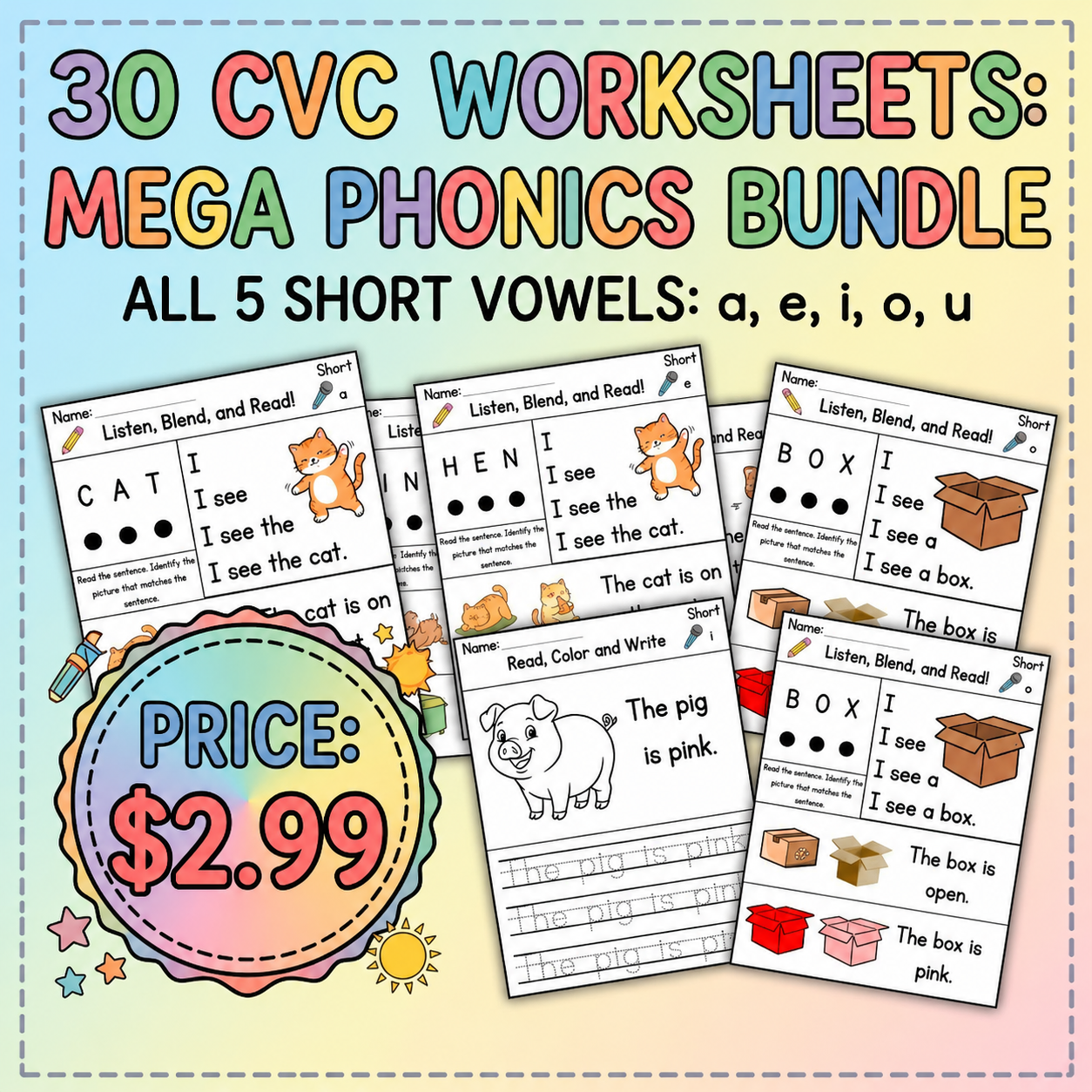
Our Science of Reading Aligned CVC Blending Worksheets — gmdock Phonics Pack ($2.49) is explicitly designed around the principles of structured phonics: systematic sound introduction, explicit blending practice, decodable text, and graduated difficulty. It reflects the research consensus in a practical, accessible format for both classroom and home use.
What This Means for Your Child
If your child's school uses a programme that emphasises context clues, picture clues or memorising sight words as primary reading strategies, it is worth supplementing at home with structured phonics practice. Children who do not receive explicit phonics instruction often develop compensatory strategies — guessing, memorising, using pictures — that work adequately in early grades but break down when text becomes more complex.
Frequently Asked Questions
Does my child need phonics if they are already reading?
Children who appear to be reading by memorisation often have significant gaps in phonics knowledge that become apparent when they encounter unfamiliar words. A quick nonsense-word test is a reliable way to assess whether decoding is actually in place.
Is there any role for sight word memorisation?
High-frequency irregular words (said, was, the, have) do benefit from some memorisation because they contain irregular spellings. But the list of truly irregular words is much shorter than most people think, and even those words can be partially decoded.
Should I be concerned if my child's school uses balanced literacy?
Many balanced literacy programmes are moving towards greater phonics inclusion in response to the research consensus. Ask specifically whether phonics instruction is systematic and explicit, and whether decodable texts are used.
Teaching Reading With the Evidence
The science of reading is not a fad — it is the accumulated result of decades of research across multiple countries. Teaching reading in alignment with that evidence gives every child the best possible chance of becoming a confident, independent reader.