Ask any kindergarten teacher what single skill gap holds back the most beginning readers, and the answer is almost always the same: short vowels. The five short vowel sounds — /a/ in cat, /e/ in bed, /i/ in sit, /o/ in hop, /u/ in bug — appear in the majority of early reading texts. A child who confuses them reads haltingly and loses comprehension. The fix is explicit, sequenced teaching — not more exposure.
Why Short Vowels Are Harder Than They Look
Consonants have distinctive visual and physical cues — you can see and feel the difference between /b/ and /p/. Short vowels are produced deep in the mouth with little visible movement. Short /e/ and short /i/ are acoustically similar and frequently confused even by children otherwise progressing well. The solution is deliberate, multisensory teaching: hear it, see it, say it, write it — all in the same session.
The Right Teaching Sequence
Most structured literacy programmes introduce short vowels in this order: a, i, o, u, e. Short /a/ and short /i/ are most acoustically distinct from each other, so beginning there minimises early confusion. Short /e/ is introduced last because it is the most commonly confused, and by then children have enough experience to sort it out. Do not move to the next vowel until the current one is fully automatic in both reading and spelling — test with a quick five-word dictation.
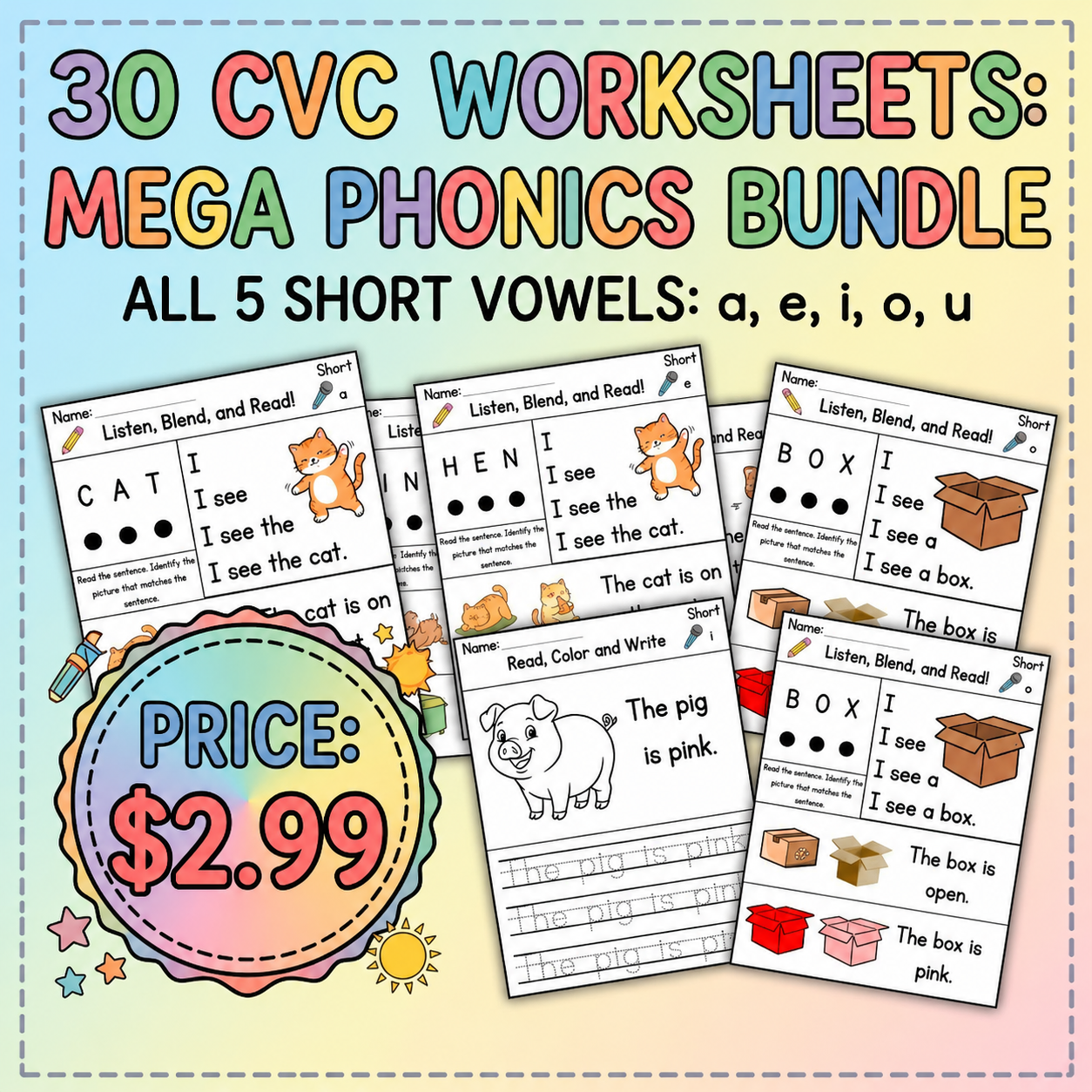
Our Short Vowel Phonics: Read and Color Sentences (A, E, I, O, U) ($1.99) introduces all five short vowels in illustrated sentence contexts, helping children connect sounds to meaning from the very first page.
Multisensory Techniques That Work
Elkonin boxes (sound boxes): Draw a row of squares, one per phoneme. The child pushes a counter into each box while saying each sound, then blends back to say the whole word. This makes each phoneme tangible and slows down the decoding process just enough to make it conscious.
Arm tapping: Touch the shoulder for the first sound, the elbow for the middle, the wrist for the last. Blend by running a hand down the arm. Kinaesthetic learners respond particularly well to this.
Vowel gestures: Assign a hand gesture to each short vowel. The gesture provides a retrieval cue when a child is stuck mid-word — far more effective than simply being told the answer.
Building from Words to Sentences
Once a child reads individual CVC words with a target vowel accurately, move to decodable sentences as quickly as possible. Comprehension is always the destination — phonics is the road. Connect this with what you learned in CVC Word Families: The Fastest Path to Early Reading — the two skills compound each other beautifully.
Frequently Asked Questions
My child knows short vowels in isolation but misses them in words. Why?
Isolated vowel identification and in-word decoding are different processes. Increase practice with CVC word reading in mixed sets — words with different vowels presented randomly — until the child can discriminate without contextual support.
Should I teach long vowels at the same time?
No. Introduce long vowels only after short vowels are fully automatised. Mixing them too early is one of the most common causes of reading confusion in kindergarten and grade 1.
Build Real Reading Confidence
Short vowel mastery is the gateway to everything that comes next in phonics. Get it solid early and the rest of the reading journey becomes dramatically smoother. Browse our phonics worksheet collection for sequenced resources that take children from their first vowel sound to fluent decodable reading.