Want to see real progress in your child's skills? The strategies around multi-sensory learning that we'll cover in this post have been tested by educators and loved by parents.
Adapting for Different Learning Styles
Some children learn best through seeing (visual learners), others through hearing (auditory learners), and many through doing (kinesthetic learners). The best activities engage multiple senses simultaneously.
Printable worksheets can be adapted for all learning styles: visual learners benefit from colorful, illustrated pages; auditory learners can read instructions aloud; kinesthetic learners can trace, cut, and paste.
Common Mistakes to Avoid
One of the biggest mistakes parents and teachers make is moving too quickly. Mastery takes time, and children need repeated exposure to concepts before they truly internalize them. If a child hasn't mastered a skill, repeating the practice is not failure — it's smart teaching.
Another common pitfall is relying on a single type of activity. Children learn best through variety: tracing one day, cutting and pasting the next, oral practice after that. Mix up your approach to keep things fresh.
Ready to put these ideas into practice? Our Label It, Write It! CVC "O" Words Activity Pack gives your child structured, engaging worksheets designed by educators. Starting at just $1.99.
When to Seek Extra Support
If your child consistently struggles with age-appropriate tasks despite regular practice, it may be worth consulting with their teacher or a developmental specialist. Early intervention is incredibly effective — the sooner challenges are identified, the more options are available.
Remember that needing extra support is not a reflection of your parenting or teaching. Some children simply need different approaches, and there's no shame in seeking guidance from professionals who specialize in early learning.
Need something quick? Our free Shape Tracing Worksheets lets you create and print personalized worksheets in seconds.
Putting Theory into Practice
Understanding concepts is important, but the real learning happens when children apply what they know through hands-on practice. Worksheets, activities, and real-world applications all help cement new skills.
Aim for a balance of guided practice (where you work alongside your child) and independent practice (where they work alone). Both are essential for building competence and confidence.
For a hands-on approach, use our free Name Tracing Generator to generate custom activities your child will love.
Why This Matters for Young Learners
Research consistently shows that children who receive quality early education are more likely to succeed academically and socially in later years. The skills developed during ages 3-7 form the foundation for all future learning.
When children engage with structured activities — whether worksheets, hands-on projects, or guided play — they build neural pathways that support reading, math, and critical thinking. The key is consistency and making learning enjoyable.
Making It Fun: Practical Ideas
Turn learning into a game whenever possible. Use timers for friendly challenges ("Can you trace all the letters before the timer goes off?"), offer sticker rewards for completed worksheets, or create a simple chart to track achievements.
Involve your child in choosing activities. When children have a say in what they work on, they're more engaged and more likely to persevere through challenging tasks.
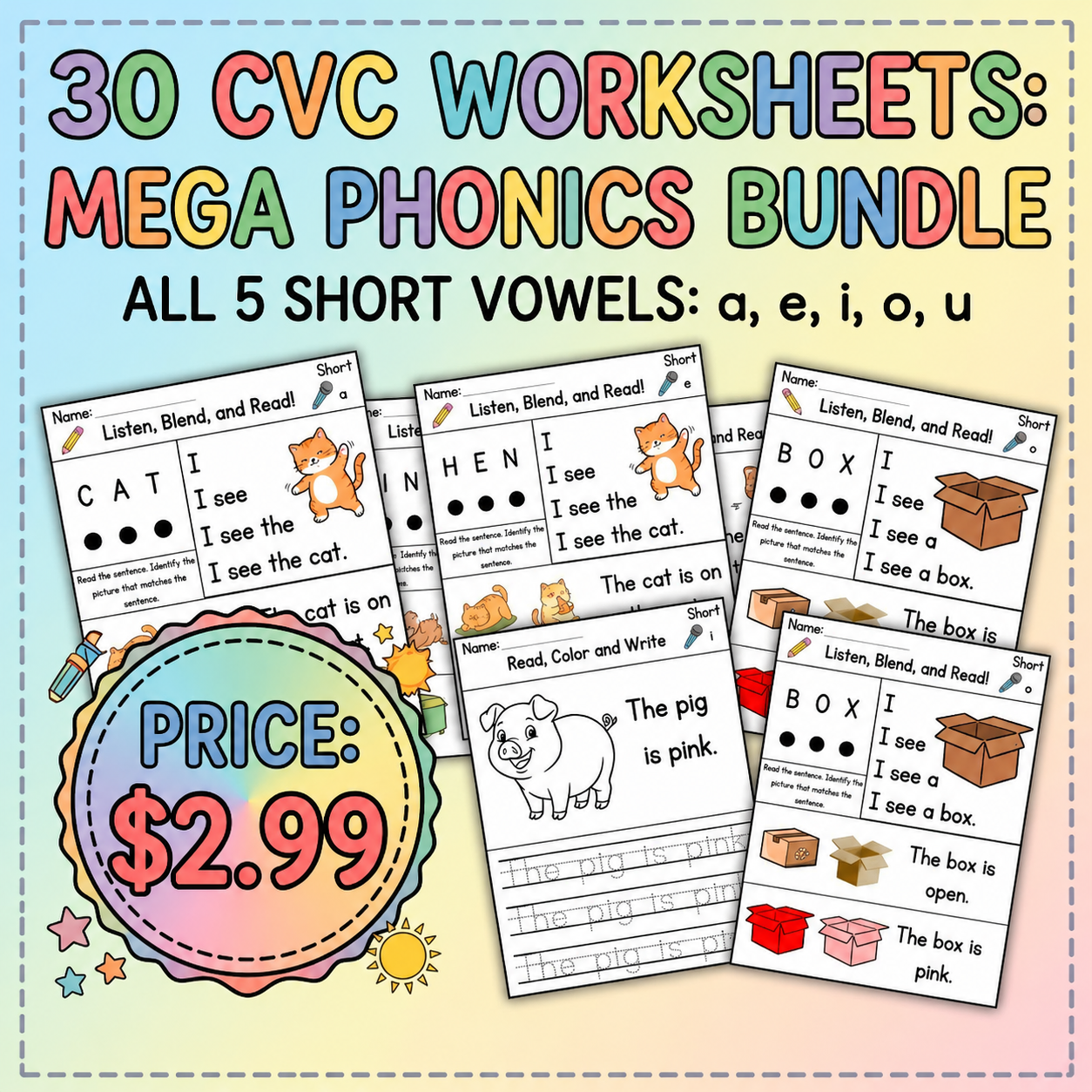
Looking for ready-made resources? The Short Vowel CVC Words Practice Pack is packed with activities that reinforce exactly these skills. Grab it for just $1.99 — instant download, print as many times as you need.
Browse our full collection of Pre-K Worksheets for more resources like these.
Frequently Asked Questions
What's the best way to motivate a reluctant learner?
Offer choices (let them pick which worksheet to do), use a reward system (stickers, stamps), keep sessions short, and always end on a positive note. Making learning feel like play rather than work is the most effective motivator.
Can I use the same worksheets multiple times?
Absolutely! Print-and-use PDF worksheets can be printed as many times as needed. Repetition is actually beneficial — children build mastery through repeated practice with familiar materials.
Are printable worksheets effective for early learning?
Yes, when used as part of a balanced approach that includes hands-on activities, play, and real-world experiences. Worksheets provide structured practice that reinforces skills taught through other methods.
How do I know which worksheets are right for my child's level?
Choose worksheets where your child can complete about 80% independently. If everything is too easy, move to more challenging material. If they struggle with more than half, step back to an easier level.
You Might Also Enjoy
- 10 Screen-Free Learning Activities for 3-Year-Olds
- Understanding Developmental Milestones: Ages 3-6 — Expert Advice
Ready to See Real Progress?
Consistent practice with quality materials makes all the difference. Our worksheets are designed to be engaging, effective, and easy to use — so you can spend less time preparing and more time teaching.
Shop all worksheets or try our free samples to get started.