Before children can decode words while reading, they need to hear the smaller parts within words. Syllable counting is one of the earliest phonological awareness skills children develop, and it lays the groundwork for blending sounds, segmenting words, and eventually sounding out text.
What Is a Syllable?
A syllable is a beat or chunk in a word. Every syllable contains a vowel sound. "Cat" has one syllable. "Tiger" has two. "Butterfly" has three. Young children don't need to understand the technical definition. They just need to hear and feel the beats.
Methods for Counting Syllables
Clapping Method
This is the most popular approach. Say a word and clap once for each syllable: "Wa-ter-mel-on" (clap-clap-clap-clap). Start with your child's name, which is inherently motivating. "Em-i-ly" gets three claps.
Chin Touch Method
Place your hand under your chin and say a word slowly. Your chin drops for each vowel sound, which corresponds to each syllable. This helps children who struggle with the clapping method because it gives a physical, automatic cue.
Stomping and Marching
Some children learn better through big body movements. March around the room and stomp once for each syllable. "Di-no-saur" gets three big stomps. This is especially effective for energetic learners who need to move.
Robot Talk
Speak like a robot, breaking words into choppy syllable chunks: "EL - E - PHANT." Children love the silliness factor, and it makes the syllable breaks crystal clear.
Practice Activities
Syllable Sort
Gather small objects or picture cards and sort them by syllable count. One pile for 1-syllable words (cat, ball, tree), another for 2-syllable words (apple, table, happy), and a third for 3+ syllable words (umbrella, dinosaur, watermelon).
Name Graph
Write the names of family members, friends, or classmates on a chart and count the syllables in each. Create a bar graph showing which syllable count is most common. This sneaks in math skills too.
Printable Support
Worksheets that pair pictures with syllable counting boxes help children practice independently. They say the word, clap the syllables, then color or mark the correct number of boxes. Our pre-K worksheets include syllable counting activities that build this essential skill.
For additional phonics and phonological awareness practice, try our spelling test generator with simple words grouped by syllable count. You can also pair syllable work with our word tracing tool to practice writing the words your child is segmenting.
When to Start
Most children can begin syllable clapping around age 3-4. By kindergarten, they should be able to count syllables in 2-3 syllable words consistently. Keep sessions playful and brief, and your child will develop this foundational skill naturally.
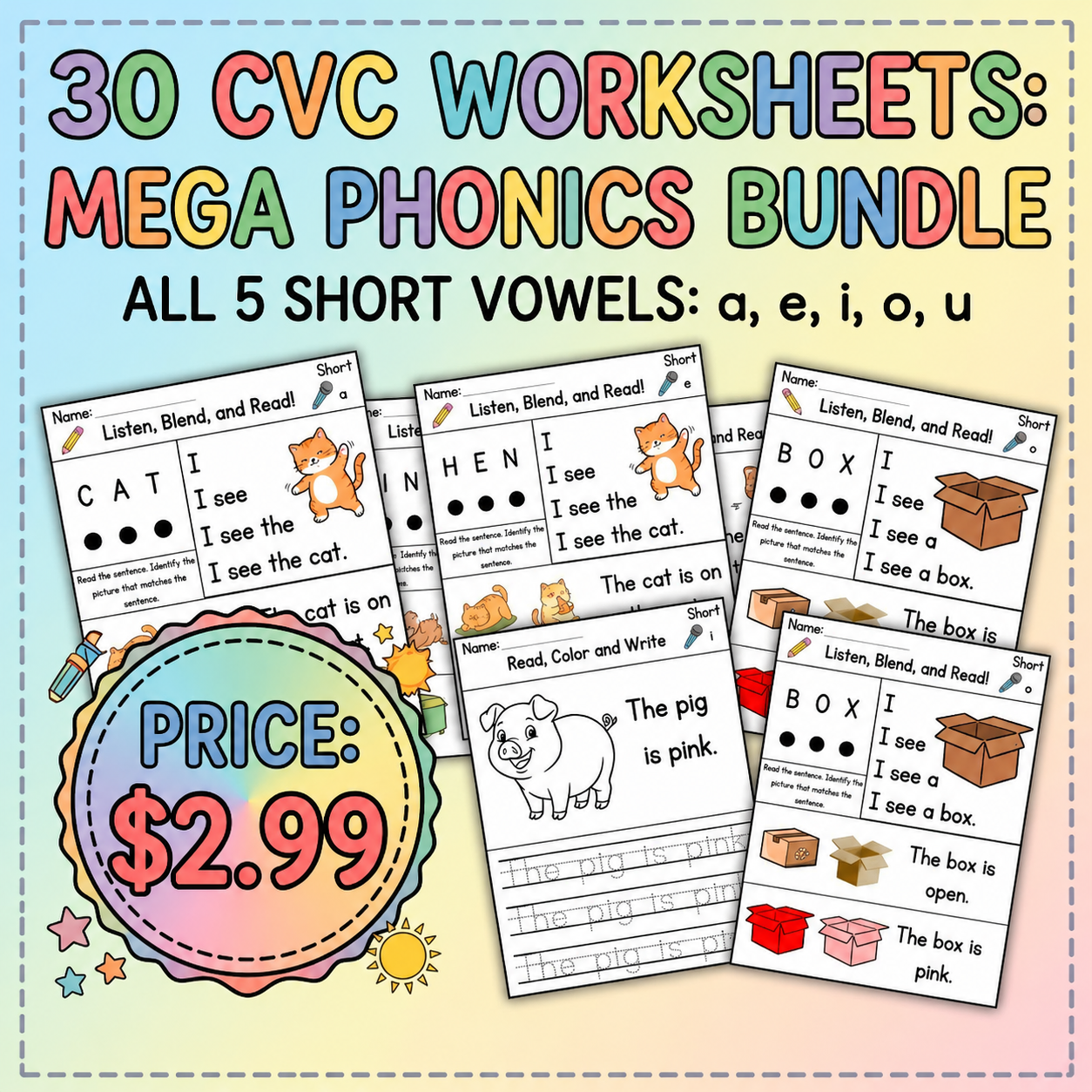
Looking for a structured way to practise this at home or in the classroom? Our Phonics Mastery Bundle: Blends, Passages & Short Vowels ($2.50) gives you everything you need in one ready-to-use printable pack.