Short /e/ as in "bed" and short /i/ as in "bit" are the two vowels children mix up most — because acoustically, they are the closest pair. The fix is not more practice on both at once; it is sequencing. Teach /i/ until it is automatic, then introduce /e/. Most systematic phonics programmes recommend: a, i, o, u, e — with /e/ last for exactly this reason.
Why Short Vowels Are the Foundation of Early Reading
Short vowels — the sounds in cat (/a/), bed (/e/), sit (/i/), hot (/o/) and cup (/u/) — appear in the majority of simple English words and underpin every CVC, CCVC and CVCC word children encounter in early reading texts. Mastering all five short vowels is not optional; it is the bedrock on which all subsequent phonics learning is built. Yet short vowels are the most commonly skipped-over in informal phonics instruction, producing the medial vowel confusion that derails many early readers. Also read: Short Vowel Mastery: The Foundation Every Early Reader Needs.
Short A: The Best Starting Point
Short /a/ as in "cat" is the most distinct of the five vowels acoustically and appears in the highest-frequency CVC words (cat, sat, hat, bat, man, ran, can). Start here. The Short A Phonics Read and Rhyme Workbook ($2.49) provides sustained practice on /a/ across reading and rhyming activities — making short /a/ the most consolidated vowel before moving on.

Multi-Vowel Practice: Stretch, Blend, Color
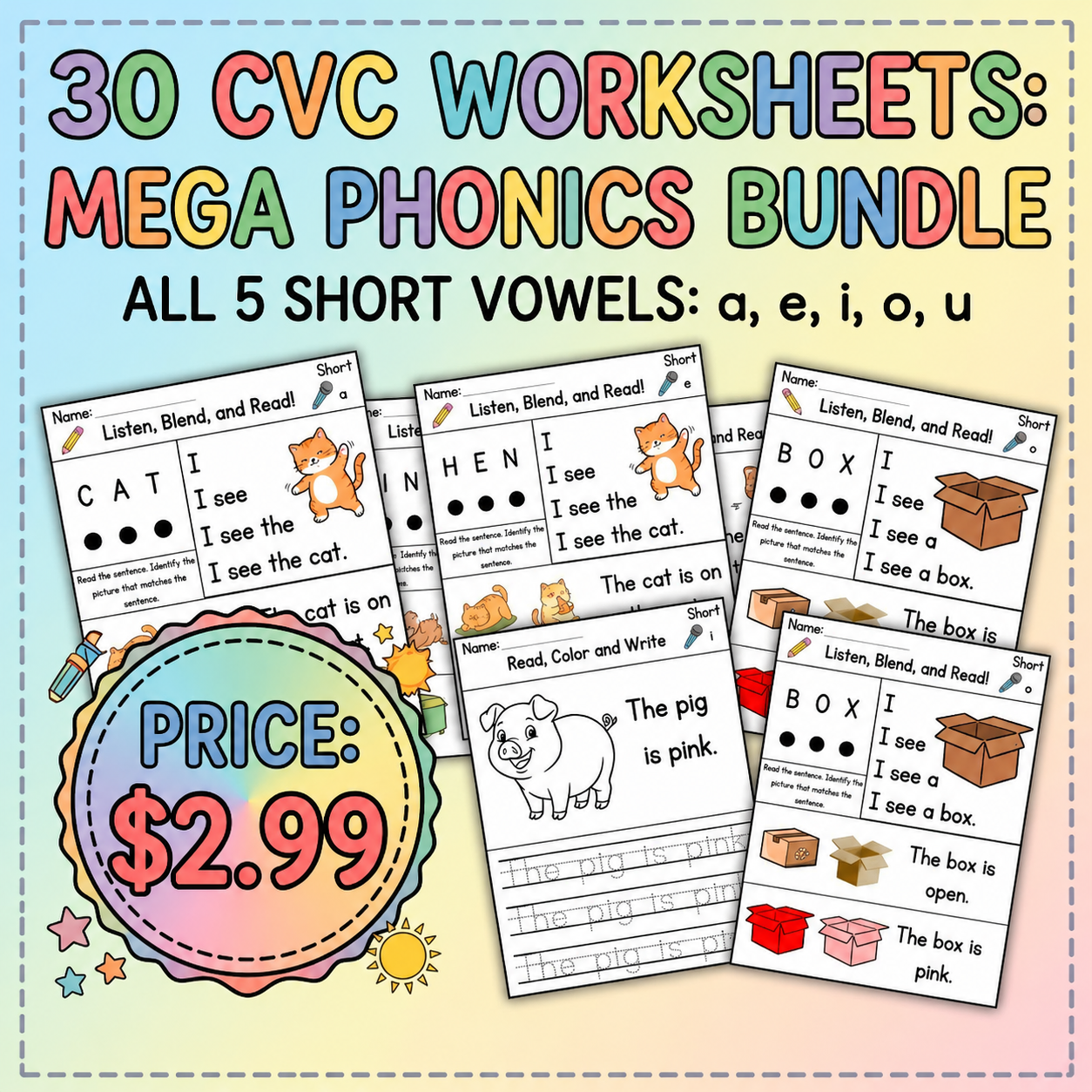
Once individual vowels are introduced, multi-vowel comparison practice is essential. The Short Vowel Phonics Worksheets — Stretch, Blend, Color ($2.99) covers all five short vowels with 30 pages of activities that build discrimination between vowels — preventing the /e/-/i/ confusion. The Stretch-Blend sequence — saying sounds slowly then blending — mirrors the explicit blending strategy most struggling readers need most.
Comprehensive Short Vowel Coverage
For complete short vowel coverage across multiple activity types, the Phonics & Reading Comprehension Mega Bundle — Short Vowels ($2.49) provides the broadest single-purchase option. Reading comprehension passages at the short vowel level give children the experience of applying phonics knowledge to connected text — the bridge between isolated phonics practice and actual reading.
Additional short vowel resources: Short Vowel Words for Easy Learning ($1.49), Short U Read and Match Sentences ($1.49), and Short Vowel CVC Words Practice Pack ($1.99) for targeted single-vowel work.
Practical Tips: Teaching Short Vowels Without Confusion
- Teach one vowel at a time and consolidate fully before introducing the next. Children who have learned /a/, /e/ and /i/ in rapid succession often confuse them.
- Use the sequence a, i, o, u, e — /e/ comes last because it is acoustically closest to /i/ and is best introduced after /i/ is fully established.
- Use nonsense words to check mastery. If a child can read "bif," "mop," and "hes" without hesitation, short vowel mastery is established — they cannot rely on word recognition, only phonics.
- Pair reading with dictation. A child may read "cat" correctly by recognising the pattern but spell it "cit" because medial vowel identification is not yet reliable for encoding. Dictation practice addresses this specifically.
Frequently Asked Questions
In what order should I teach the five short vowels?
Most programmes recommend: a, i, o, u, e. Short /e/ comes last because it is acoustically most similar to /i/ and is best introduced after /i/ is fully established.
My child can read short vowel words but spells them incorrectly. Why?
Reading (decoding) and spelling (encoding) are related but distinct skills. A child may read "cat" correctly by recognising the word pattern but spell it "cit" because the medial vowel identification is not yet reliable for encoding. Dictation practice addresses this specifically.
How do I know when short vowels are mastered?
When a child can read any unfamiliar CVC word containing any of the five short vowels without hesitation, and can correctly identify the medial vowel in nonsense CVC words (bif, mop, hes), short vowel mastery is established.
The Vowels That Unlock Early Reading
Every CVC word contains a short vowel. Every early reading text is built from them. Sequence the instruction correctly, consolidate each vowel before moving on, and the reading will follow naturally.


