Want to see real progress in your child's skills? The strategies around long vs short vowels that we'll cover in this post have been tested by educators and loved by parents.
The Role of Repetition
Neuroscience tells us that repetition strengthens neural connections. When a child traces the same letter multiple times across different worksheets, they're not just practicing — they're literally building stronger brain pathways for that skill.
The key is to vary the format while keeping the core skill the same. Tracing, writing from memory, identifying in text, and forming with playdough all reinforce letter knowledge through different modalities.
Why This Matters for Young Learners
Research consistently shows that children who receive quality early education are more likely to succeed academically and socially in later years. The skills developed during ages 3-7 form the foundation for all future learning.
When children engage with structured activities — whether worksheets, hands-on projects, or guided play — they build neural pathways that support reading, math, and critical thinking. The key is consistency and making learning enjoyable.
Looking for ready-made resources? The Digraph Sounds Worksheets PH, WH, TH, SH, CH, CK is packed with activities that reinforce exactly these skills. Grab it for just $2.99 — instant download, print as many times as you need.
Understanding Phonics: The Building Blocks of Reading
Phonics is the relationship between letters and sounds. When children understand that the letter "b" makes the /b/ sound, they've taken the first step toward reading independently.
Systematic phonics instruction — teaching sounds in a logical, sequential order — is the most effective approach according to decades of reading research. Start with single consonant sounds, move to short vowels, then blend them into simple CVC (consonant-vowel-consonant) words.
Quick tip: Try our free Alphabet Tracing Tool to create custom practice sheets tailored to your child's needs — no signup required.
Creating Consistency Without Burnout
The secret to effective early education isn't marathon study sessions — it's consistent, brief daily practice. Even 10 minutes of focused work each day adds up to over 60 hours of practice per year.
Build learning into your existing routine. Worksheet time after breakfast, flashcard review before bed, or letter identification during grocery shopping — these small moments compound into significant learning gains.
For a hands-on approach, use our free Alphabet Tracing Tool to generate custom activities your child will love.
CVC Words: The Gateway to Reading
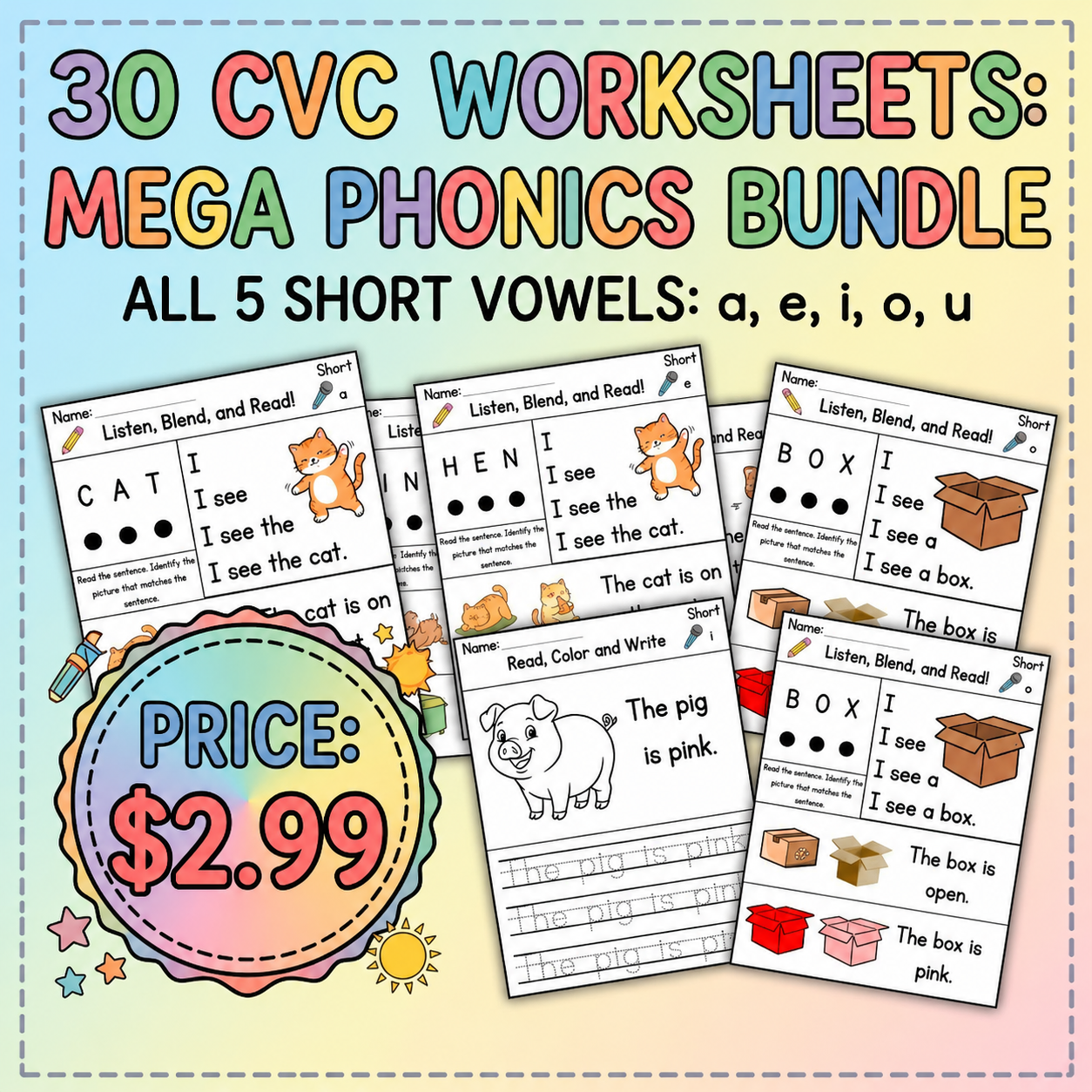
CVC words like "cat," "dog," and "sun" are typically the first words children learn to read independently. These simple three-letter words follow predictable patterns that help children understand how sounds blend together.
Practice CVC words through multiple activities: reading them aloud, writing them, identifying them in text, sorting them by word family, and using them in simple sentences. The more exposure, the faster fluency develops.
Common Mistakes to Avoid
One of the biggest mistakes parents and teachers make is moving too quickly. Mastery takes time, and children need repeated exposure to concepts before they truly internalize them. If a child hasn't mastered a skill, repeating the practice is not failure — it's smart teaching.
Another common pitfall is relying on a single type of activity. Children learn best through variety: tracing one day, cutting and pasting the next, oral practice after that. Mix up your approach to keep things fresh.
Ready to put these ideas into practice? Our Phonics Mastery Bundle: Blends, Passages, & Short Vowels gives your child structured, engaging worksheets designed by educators. Starting at just $2.50.
Browse our full collection of Kindergarten Worksheets for more resources like these.
Frequently Asked Questions
What's the best way to motivate a reluctant learner?
Offer choices (let them pick which worksheet to do), use a reward system (stickers, stamps), keep sessions short, and always end on a positive note. Making learning feel like play rather than work is the most effective motivator.
At what age should a child start learning phonics?
Most children are ready for basic phonics instruction around age 4-5, starting with letter sounds and simple CVC words. However, informal exposure through reading aloud and singing alphabet songs can begin much earlier.
What are CVC words and why are they important?
CVC stands for Consonant-Vowel-Consonant. Words like "cat," "dog," and "sun" follow this pattern. They're the simplest decodable words and serve as the foundation for all early reading development.
How much time should young children spend on worksheets each day?
For children ages 3-6, 10-20 minutes of focused worksheet time is ideal. Keep sessions short and positive, and always stop before frustration sets in. Consistency matters more than duration.
How many sight words should a kindergartener know?
By the end of kindergarten, most children can recognize 20-50 sight words. However, the exact number varies, and it's more important that children can decode phonetically regular words than memorize sight words.
You Might Also Enjoy
- 8 Team-Building Activities for Young Learners
- Small Group vs. Whole Group Instruction for Kindergarten
- How to Teach Place Value to Preschoolers
Start Your Child's Learning Journey Today
Every great reader, writer, and problem-solver started with the basics. The activities and strategies we've discussed today are your roadmap to building a strong educational foundation.
Browse our complete collection of printable worksheets and find the perfect resources for your child's learning level. With instant digital downloads starting under $2, there's no reason to wait.