Early childhood education lays the groundwork for a lifetime of learning. Whether you're a parent, teacher, or homeschooler, mastering reading fluency will make a meaningful difference in your child's development.
The Role of Repetition
Neuroscience tells us that repetition strengthens neural connections. When a child traces the same letter multiple times across different worksheets, they're not just practicing — they're literally building stronger brain pathways for that skill.
The key is to vary the format while keeping the core skill the same. Tracing, writing from memory, identifying in text, and forming with playdough all reinforce letter knowledge through different modalities.
Creating Consistency Without Burnout
The secret to effective early education isn't marathon study sessions — it's consistent, brief daily practice. Even 10 minutes of focused work each day adds up to over 60 hours of practice per year.
Build learning into your existing routine. Worksheet time after breakfast, flashcard review before bed, or letter identification during grocery shopping — these small moments compound into significant learning gains.
Ready to put these ideas into practice? Our Digraph Sounds Worksheets PH, WH, TH, SH, CH, CK gives your child structured, engaging worksheets designed by educators. Starting at just $2.99.
CVC Words: The Gateway to Reading
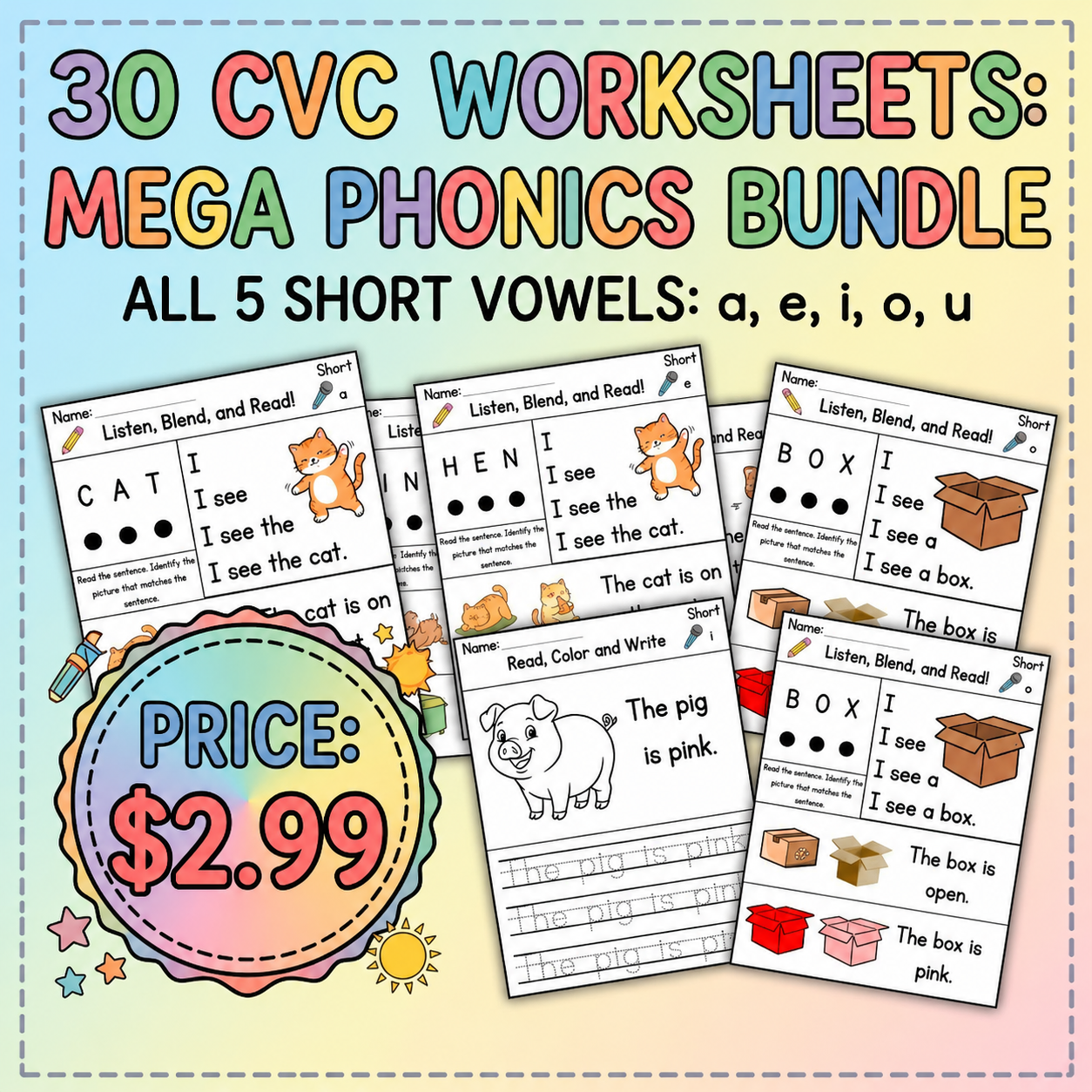
CVC words like "cat," "dog," and "sun" are typically the first words children learn to read independently. These simple three-letter words follow predictable patterns that help children understand how sounds blend together.
Practice CVC words through multiple activities: reading them aloud, writing them, identifying them in text, sorting them by word family, and using them in simple sentences. The more exposure, the faster fluency develops.
For a hands-on approach, use our free Alphabet Tracing Tool to generate custom activities your child will love.
Building from Sounds to Stories
Once children can decode simple CVC words, they're ready to tackle short decodable sentences and stories. This progression from individual sounds to connected text is where the magic of reading really begins.
Choose reading materials that match your child's current phonics level. Frustration-free reading builds confidence, and confidence builds motivation to tackle more challenging texts.
Quick tip: Try our free Alphabet Tracing Tool to create custom practice sheets tailored to your child's needs — no signup required.
Blends and Digraphs: The Next Step
After mastering CVC words, children are ready for consonant blends (bl, cr, st) and digraphs (sh, ch, th, wh). These combinations appear in thousands of English words, so mastering them opens up a huge vocabulary.
Introduce one blend or digraph at a time, and provide plenty of practice before moving on. Worksheets that focus on a single sound pattern help children build automaticity without overwhelm.
What the Research Says
Studies from the National Institute for Early Education Research confirm that children who engage in regular, structured learning activities show measurable improvements in literacy and numeracy by the time they enter first grade.
The most effective approaches combine explicit instruction with playful practice. This means short, focused teaching moments followed by hands-on activities where children apply what they've learned.
Save yourself hours of prep time. The Comprehension Worksheets - Kindergarten Reading Comprehension includes everything you need, professionally designed and classroom-tested. Only $2.49.
Browse our full collection of Preschool Worksheets for more resources like these.
Frequently Asked Questions
How can I help my struggling reader at home?
Focus on phonics-based practice with decodable texts at your child's level. Keep sessions short (10-15 minutes), celebrate small wins, and avoid frustration. Consistent daily practice matters more than session length.
How do I know which worksheets are right for my child's level?
Choose worksheets where your child can complete about 80% independently. If everything is too easy, move to more challenging material. If they struggle with more than half, step back to an easier level.
Can I use the same worksheets multiple times?
Absolutely! Print-and-use PDF worksheets can be printed as many times as needed. Repetition is actually beneficial — children build mastery through repeated practice with familiar materials.
You Might Also Enjoy
- The Difference Between Phonics and Phonemic Awareness — What Parents Need To Know
- Decodable Readers vs. Leveled Readers: Which Is Better? — Fun Ideas
- 12 Phonics Worksheets Every Pre-K Teacher Needs
Ready to See Real Progress?
Consistent practice with quality materials makes all the difference. Our worksheets are designed to be engaging, effective, and easy to use — so you can spend less time preparing and more time teaching.
Shop all worksheets or try our free samples to get started.