Have you ever wondered why young children can learn new words, songs, routines, and behaviors so quickly — often without anyone formally teaching them?
A toddler may hear a phrase only a few times and suddenly start repeating it perfectly. A preschooler may remember the exact route to a favourite park, or recognise logos, sounds, and patterns that adults never intentionally taught.
This remarkable ability is often described as the absorbent mind — a concept introduced by Dr. Maria Montessori to explain how young children naturally absorb information from their environment during the early years of life.
Modern neuroscience supports many parts of this idea. Research shows that early childhood is a period of rapid brain development, when children are especially receptive to language, sounds, movement, routines, social interaction, and sensory experiences.
In simple terms: young children do not learn only through formal teaching — they learn constantly from the environment around them.
What Is the Absorbent Mind?
The absorbent mind refers to a child's natural ability to unconsciously absorb information from their surroundings during early childhood.
Unlike adults, young children do not always need direct instruction to learn. Their brains are constantly observing sounds, language, emotions, movement, routines, and patterns.
This is why children often:
- copy words they hear,
- imitate adult behaviour,
- remember repeated activities,
- and learn through everyday experiences.
During the early years, the brain is building millions of neural connections. Repeated experiences strengthen these connections and help learning become more automatic over time. This is also why the environment around a child matters so much.
What Are Sensitive Periods?
Sensitive periods are specific stages during early childhood when children are especially ready to learn certain skills.
For example, young children may show strong interest in language, movement, sounds, order, writing, or social interaction at different stages of development.
During these periods, learning often happens more naturally and with less effort — because the brain is especially receptive to those experiences.
This does not mean children cannot learn later in life. They absolutely can. However, some skills are often learned more easily and naturally during early childhood because the brain is highly adaptable during this time.
This is one reason why the preschool and kindergarten years are so important for:
- language exposure,
- phonics and early reading,
- vocabulary development,
- and communication skills.
During the sensitive period for language and sound, structured activities like beginning sound worksheets give children a focused, low-pressure way to explore the letter-sound connections their brains are already primed to notice.
Why Environment Matters So Much
If young children naturally absorb information from their surroundings, then the environment becomes one of the most powerful teaching tools available.
Children learn not only from lessons, but also from what they repeatedly see, what they hear daily, the activities available to them, and the emotional atmosphere around them.
A prepared learning environment does not need to be expensive or complicated. It simply means creating spaces and experiences that encourage curiosity, independence, repetition, exploration, and calm learning.
For example, accessible books, hands-on activities, letter and sound games, visual materials, predictable routines, and playful learning opportunities can all support natural learning during sensitive periods.
Why Repetition Is So Important
Parents sometimes worry when children want to repeat the same activity again and again. But repetition is one of the brain's most important learning tools.
Young children often repeat activities because the brain is strengthening neural pathways through practice. Each repetition helps:
- improve memory,
- build confidence,
- strengthen coordination,
- and increase understanding.
This is especially true in early phonics and reading development. When children repeatedly practise letter sounds, blending, matching activities, tracing, and sound recognition, the brain gradually becomes faster and more automatic at processing those skills.
Worksheets that build in structured repetition — like read, trace, and colour activities — work well here precisely because they give the brain multiple passes through the same skill in a single session. Our CVC Mastery Phonics Packet is designed around this principle: 35 pages of read, trace, dab, and create activities that keep repetition engaging instead of passive.
Repetition does not have to feel boring when learning is interactive and playful.
Why Playful Learning Works Best
Young children learn most effectively when they feel emotionally safe, engaged, and curious. Research in child development shows that stress and emotional overwhelm can reduce the brain's ability to focus, process information, and retain learning.
In contrast, playful and low-pressure learning experiences help children stay engaged longer, participate more willingly, repeat activities naturally, and build positive associations with learning.
This is why hands-on activities are often more effective than long lectures for preschool and kindergarten children.
Simple activities such as blending games, puzzles, matching exercises, sensory activities, movement-based learning, and interactive phonics practice allow children to learn actively instead of passively memorising information. If you are exploring why hands-on phonics activities build stronger readers, the answer is rooted in exactly this — active engagement during sensitive periods produces stronger, more durable learning.
How Parents and Teachers Can Use Sensitive Periods Practically
Understanding sensitive periods does not mean pressuring children to learn faster. Instead, it means noticing what children are naturally interested in and providing supportive opportunities for exploration.
Practical ways to support learning during sensitive periods include:
- reading aloud daily,
- talking with children frequently,
- introducing playful phonics activities,
- creating predictable routines,
- limiting unnecessary stress,
- allowing and encouraging repetition,
- and keeping learning sessions short and engaging.
The goal is not to force learning. The goal is to prepare an environment where learning can happen naturally.
Why Early Literacy Exposure Matters
During the preschool and kindergarten years, children are especially receptive to language and sound patterns. This makes early exposure to phonics, blending, rhyming, storytelling, and vocabulary activities particularly valuable.
Understanding why phonemic awareness must come before phonics instruction is one of the most practical insights from this research — children need to hear and manipulate sounds before they can reliably connect them to letters on a page.
Children who regularly interact with language-rich and print-rich environments begin developing stronger foundations for reading, comprehension, communication, and writing. Even simple daily activities can make a meaningful difference over time.
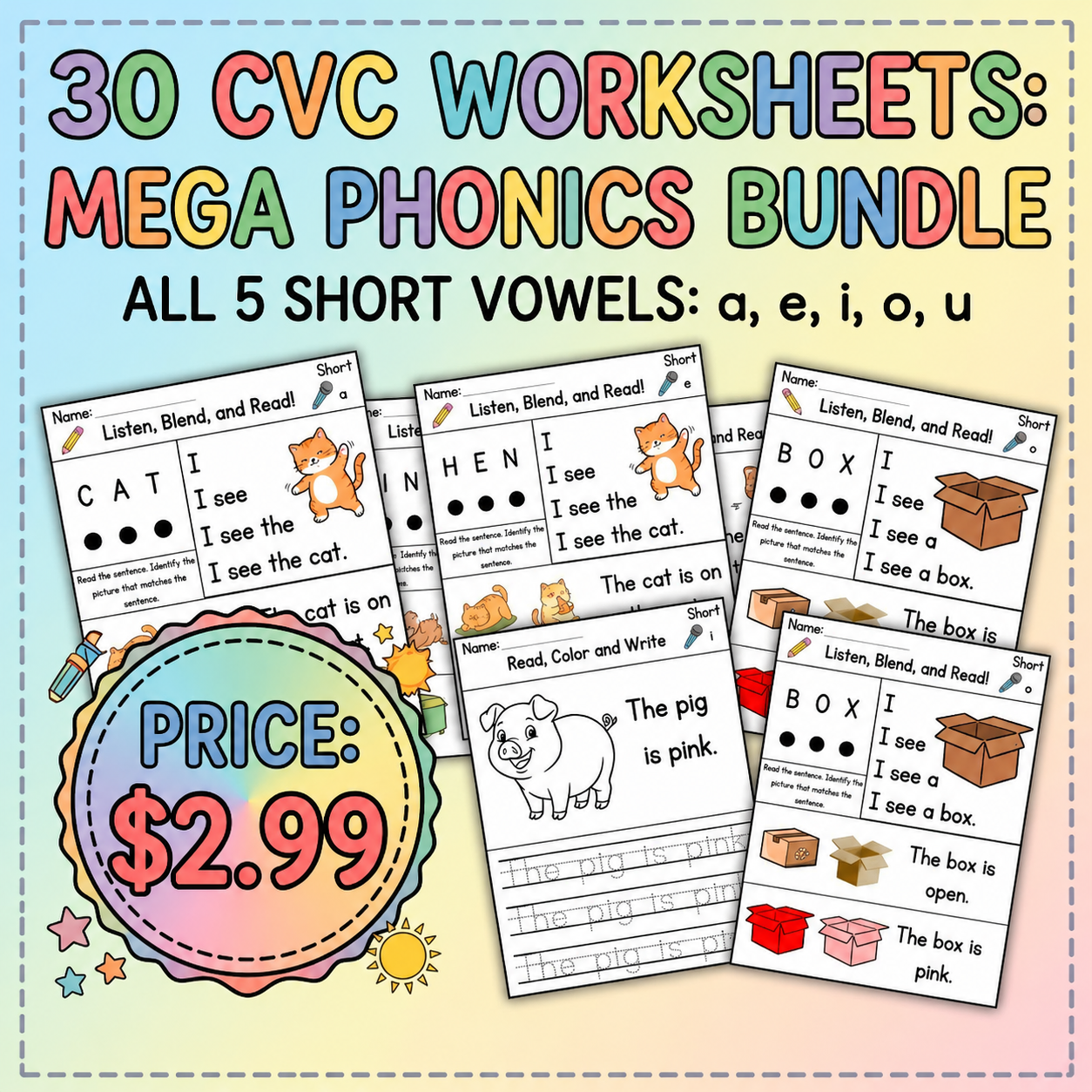
Structured resources like our 30 CVC Phonics Worksheets give children consistent, bite-sized exposure to the exact letter-sound patterns that matter most in the kindergarten years — presented in a way that suits short attention spans and thrives on repetition.
For a deeper look at how blending specifically supports reading and brain development, see: The Science Behind Blending: How It Builds Reading, Language, and Brain Development in Children.
Final Thoughts
Young children are naturally designed to absorb information from the world around them. During early childhood, the brain is highly responsive to language, sounds, movement, repetition, and sensory experiences.
This is why emotionally safe, playful, and well-prepared learning environments are so powerful. When adults provide supportive experiences instead of pressure, children are more likely to stay curious, enjoy learning, build confidence, and develop strong foundations for future academic success.
The early years are not about forcing children to achieve more. They are about giving the developing brain meaningful experiences to absorb naturally.
Supporting Your Child's Sensitive Periods at Home
Our phonics and early learning worksheets are designed to support playful, structured, and developmentally appropriate learning — helping children build strong foundations through repetition, interaction, and confidence-building activities.
- Kindergarten Phonics Pack: 40 CVC Worksheets — match, colour, and find activities for ages 4–6
- CVC Mastery Phonics Packet — 35 pages of read, trace, dab & create
- Beginning Sound Worksheets — 32 pages supporting early phonemic awareness
All resources are printable PDFs — instant download, unlimited printing.