Looking for evidence-based approaches to questions about school? You've come to the right place. We've compiled insights from educators, child development experts, and parents who have seen real results.
Why This Matters for Young Learners
Research consistently shows that children who receive quality early education are more likely to succeed academically and socially in later years. The skills developed during ages 3-7 form the foundation for all future learning.
When children engage with structured activities — whether worksheets, hands-on projects, or guided play — they build neural pathways that support reading, math, and critical thinking. The key is consistency and making learning enjoyable.
Building Independence
The ultimate goal of early education is to build independent learners. Start by modeling the activity, then do it together, then let your child try with minimal help, and finally step back completely.
This gradual release of responsibility — often called "I do, we do, you do" — is one of the most effective teaching frameworks for young children.
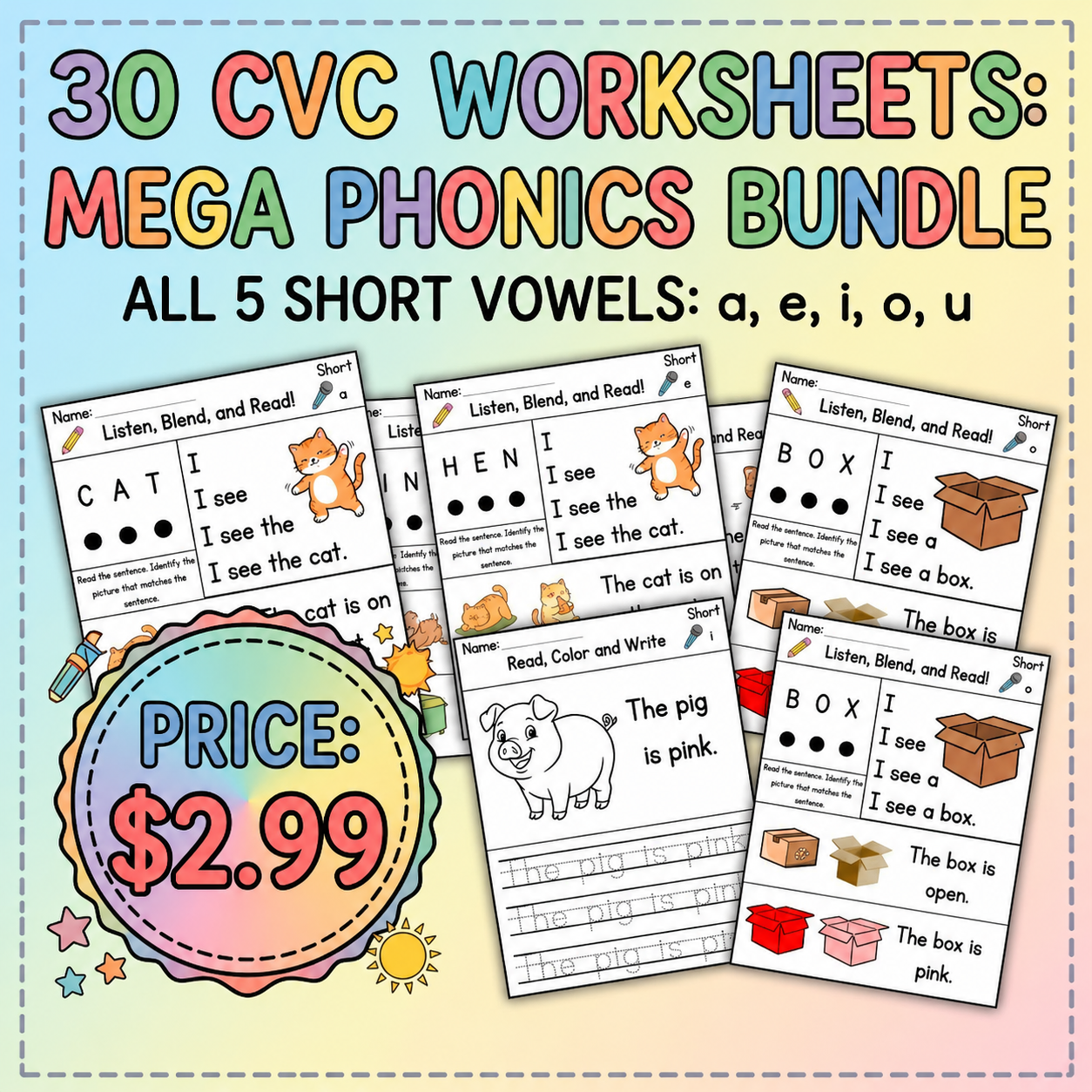
Looking for ready-made resources? The Short Vowel CVC Words Practice Pack is packed with activities that reinforce exactly these skills. Grab it for just $1.99 — instant download, print as many times as you need.
Adapting for Different Learning Styles
Some children learn best through seeing (visual learners), others through hearing (auditory learners), and many through doing (kinesthetic learners). The best activities engage multiple senses simultaneously.
Printable worksheets can be adapted for all learning styles: visual learners benefit from colorful, illustrated pages; auditory learners can read instructions aloud; kinesthetic learners can trace, cut, and paste.
Common Mistakes to Avoid
One of the biggest mistakes parents and teachers make is moving too quickly. Mastery takes time, and children need repeated exposure to concepts before they truly internalize them. If a child hasn't mastered a skill, repeating the practice is not failure — it's smart teaching.
Another common pitfall is relying on a single type of activity. Children learn best through variety: tracing one day, cutting and pasting the next, oral practice after that. Mix up your approach to keep things fresh.
What the Research Says
Studies from the National Institute for Early Education Research confirm that children who engage in regular, structured learning activities show measurable improvements in literacy and numeracy by the time they enter first grade.
The most effective approaches combine explicit instruction with playful practice. This means short, focused teaching moments followed by hands-on activities where children apply what they've learned.
Save yourself hours of prep time. The My First Words: CVC Spelling & Letter Tracing Worksheets includes everything you need, professionally designed and classroom-tested. Only $2.49.
Frequently Asked Questions
Are printable worksheets effective for early learning?
Yes, when used as part of a balanced approach that includes hands-on activities, play, and real-world experiences. Worksheets provide structured practice that reinforces skills taught through other methods.
What's the best way to motivate a reluctant learner?
Offer choices (let them pick which worksheet to do), use a reward system (stickers, stamps), keep sessions short, and always end on a positive note. Making learning feel like play rather than work is the most effective motivator.
How do I know which worksheets are right for my child's level?
Choose worksheets where your child can complete about 80% independently. If everything is too easy, move to more challenging material. If they struggle with more than half, step back to an easier level.
You Might Also Enjoy
- Summer Learning Loss: 25 Ways to Prevent the Slide
- How to Use Flashcards to Teach Letter Recognition
- 25 Questions to Ask Instead of "How Was School Today?"
- 5 Questions to Ask Instead of "How Was School Today?"
Start Your Child's Learning Journey Today
Every great reader, writer, and problem-solver started with the basics. The activities and strategies we've discussed today are your roadmap to building a strong educational foundation.
Browse our complete collection of printable worksheets and find the perfect resources for your child's learning level. With instant digital downloads starting under $2, there's no reason to wait.