Every parent dreams of the moment their child reads their first word independently. But reading readiness is not something that can be forced — it emerges when specific developmental skills come together. Understanding these readiness signs helps you provide exactly the right support at exactly the right time.
The Six Pillars of Reading Readiness
Literacy researchers identify six essential pre-reading skills that must be in place before a child can successfully learn to read:
- Print awareness — Understanding that written words carry meaning, that we read left to right, and that the print (not pictures) tells the story
- Phonological awareness — The ability to hear and manipulate sounds in spoken language, including recognizing rhymes and syllables
- Letter knowledge — Recognizing letter shapes and understanding that each letter represents a specific sound
- Vocabulary — A rich oral vocabulary of at least 2,000-3,000 words by age 5 provides the foundation for reading comprehension
- Narrative skills — The ability to describe events, retell stories, and understand story structure (beginning, middle, end)
- Motivation — A genuine interest in books, reading, and written language
Our pre-reading skill worksheets target each of these six pillars with developmentally appropriate activities.
Signs Your Child Is Approaching Reading Readiness
Watch for these behavioral indicators that suggest your child is getting ready to read:
- Pretends to read books, turning pages and telling the story from pictures
- Recognizes their own name in print and possibly a few other familiar words like "stop" or "exit"
- Points to words in books and asks "What does that say?"
- Can clap out syllables in words (but-ter-fly = 3 claps)
- Plays with language through rhyming, silly words, and made-up songs
- Recognizes most uppercase letters and can name their sounds
- Tells you stories with a clear beginning, middle, and end
Activities That Build Pre-Reading Skills
These activities strengthen the foundation your child needs to decode words successfully:
- Read aloud daily — This is the single most important thing you can do for reading development. Read a variety of genres and ask questions about the story.
- Play sound games — "What sound does 'ball' start with?" "Can you think of another word that starts with /b/?"
- Rhyme all the time — Create silly rhymes together, read rhyming books, and play "Do these words rhyme?" games throughout the day.
- Point to environmental print — Help your child recognize familiar logos, signs, and labels. This builds the understanding that print carries meaning.
- Use alphabet worksheets strategically — Our free phonics worksheets connect letters to their sounds through engaging matching and coloring activities.
Common Reading Readiness Myths
Let us clear up some misconceptions:
Myth: Children should read by age 4
Reality: Most children are not developmentally ready to read until ages 5 to 7. Some perfectly healthy, intelligent children do not read fluently until age 8. Early reading is not a reliable indicator of future academic success.
Myth: Flashcard drills speed up reading readiness
Reality: Drilling flashcards without context can actually create negative associations with reading. Meaningful, enjoyable experiences with books and language are far more effective.
Myth: More worksheets equal faster reading
Reality: Quality matters more than quantity. A few well-designed activities paired with rich reading experiences outperform stacks of low-quality worksheets every time.
What to Do If You Are Concerned
If your child is approaching age 6 and shows limited interest in letters, struggles to rhyme, or has difficulty hearing individual sounds in words, consider discussing it with your pediatrician. Early intervention for reading difficulties is extremely effective when started before age 7.
Nurture your child's reading journey with our complete pre-reading skill collection designed to build every pillar of reading readiness. For letter-specific activities, see our phonics activities guide.
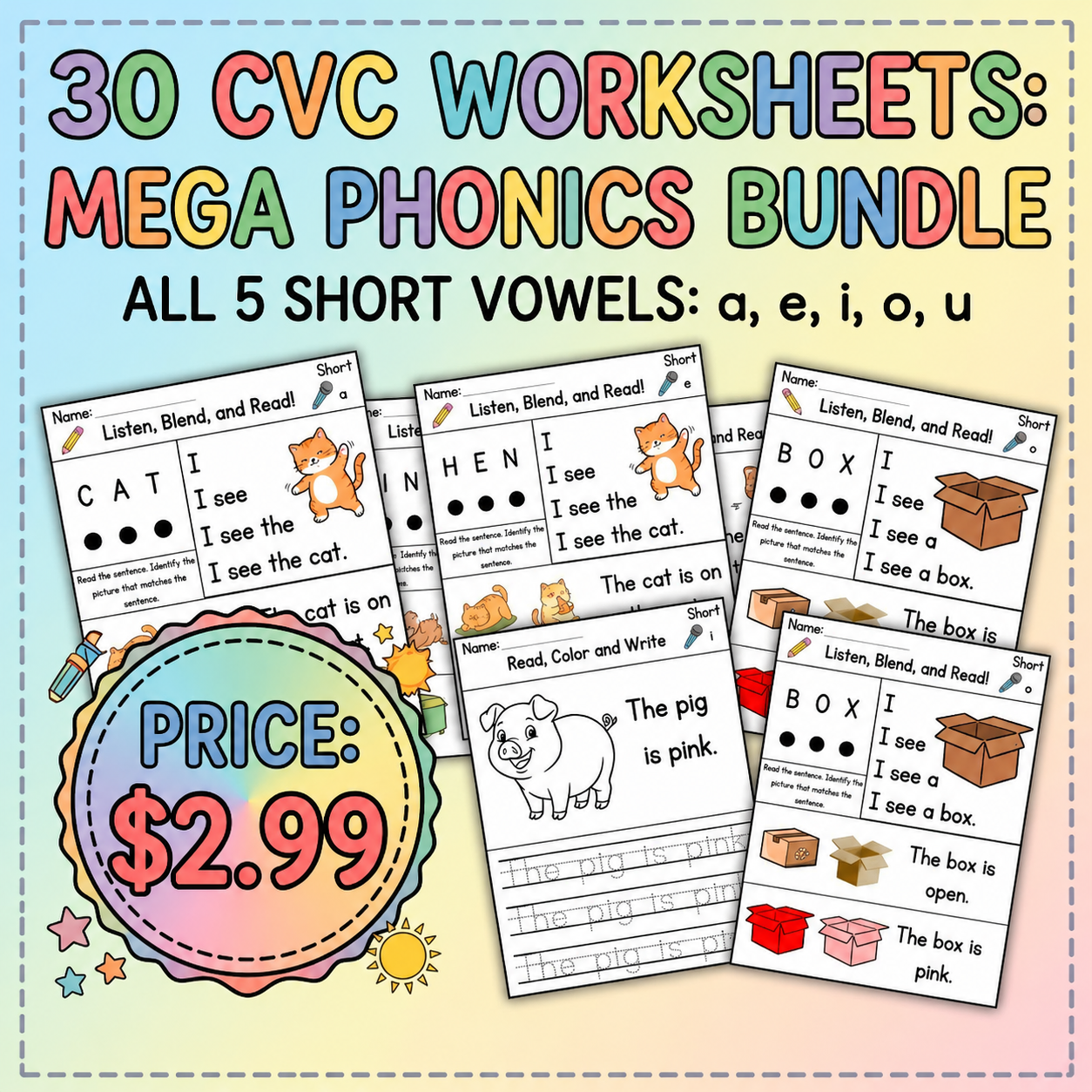
Looking for a structured way to practise this at home or in the classroom? Our 30 CVC Phonics Worksheets: Read, Trace & Color ($2.99) gives you everything you need in one ready-to-use printable pack.